
When Do You Need Solar Control glass and How Does It Work?

Open a south- or west-facing rooflight on a bright day and you feel it immediately: high, clean light, followed by a wave of warmth that lingers long after the sun moves on. Daylight is the win; unwanted heat is the trade-off. Solar control glass is the quiet fix that keeps the light while trimming the heat, and it matters most when you’re dealing with large rooflights, big banks of glazing, or walk-on glass where the sun can turn a surface into a slow-release radiator. This guide explains when solar control is worth specifying, how the coatings work, and why a popular option like SN 70/35 has become a go-to for modern homes and terraces.
At heart, solar control glass is standard architectural glass with a microscopically thin metal-oxide coating applied during manufacture. That coating is selective: it lets a high proportion of visible light pass, but reflects or absorbs a larger share of the sun’s infrared energy before it can become heat indoors. Performance is usually discussed in terms of g-value (also called Solar Heat Gain Coefficient, SHGC) the fraction of total solar energy that makes it through the glazing. The lower the g-value, the better the glazing is at resisting solar heat build-up; values sit between 0 and 1. In practice, a g of around 0.35 will feel very different to a g of 0.60 on the same roof.
The trick is keeping visible light transmission high while pushing the g-value down. That’s what modern “selective” coatings do far better than older reflective tints: they maintain good daylight levels without the mirrored look and without excessive internal glare. For rooflights and skylights this balance matters, because most of us want rooms that look bright in photographs and feel comfortable in July, not spaces that rely on blinds all summer.
When you actually need solar control
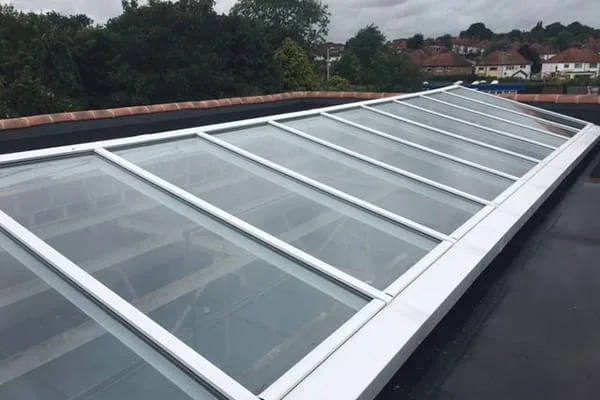
Consider it whenever the glazing area is generous relative to the room, when the unit faces south or west, or when the glass sits at a shallow pitch and “sees” a lot of sky. Loft conversions and single-storey extensions are classic candidates: open-plan kitchens with islands under large flat-roof rooflights, long living rooms lit by linear modules, and walk-on panels that double as part of a terrace. In airtight homes where you’ve worked hard to keep heat in solar gains feel stronger because the room can’t easily dump that warm air. A coating that trims those gains at source is a simple way to keep comfort predictable without chasing mechanical cooling later. For skylights specifically, you’ll often combine solar control with sensible ventilation and shading so the system works with the weather rather than fighting it.
SN 70/35 in plain English
It’s designed to look neutral (many describe a very light, cool tint rather than a mirrored façade), and it pairs that solar control with strong thermal insulation when built into a double- or triple-glazed unit. That balance light in, heat moderated is why it turns up so often in high-spec rooflights.
If your priority is a clear, modern look rather than a visibly tinted rooflight, this family of coatings is usually the sweet spot.
On flat-roof rooflights and skylights, the coating usually sits on the cavity side of the outer pane (in a double-glazed unit), where it can reject solar energy before it reaches the room. Set-up aside, what you notice is the feel of the space: surfaces don’t get quite as hot, late-afternoon peaks are blunted, and blinds become a fine-tuning device rather than a crutch. The room stays readable during the day, which is the point of having a rooflight in the first place.
Walk-on glass is a different animal because the assembly is structural. You’re dealing with multiple toughened-laminated plies, anti-slip treatments and specific load categories. Solar control still helps particularly when dark decking or rugs would otherwise heat the top ply but it should be coordinated with the structural glass make-up and with drainage around the frame to avoid hot edges. The brief doesn’t change (keep light, lose excess heat), but the detailing does, and you should treat these panels as engineered floors that happen to be transparent. Industry literature on solar-control behaviour backs the same principle: reduce the solar factor while preserving visible light to prevent overheating without greying the room down.
Does solar control glass make rooms darker?
Not if you choose well. The better coatings maintain high visible light transmission and cut mainly in the near-infrared part of the spectrum, which is where the unwanted heat lives. An option like SN 70/35 is designed to look neutral and keep the room bright; many suppliers explicitly position it for fully glazed façades and big openings because it preserves “daylight feel” while reining in gains. If you’ve lived with older reflective tints, the difference is obvious as soon as you stand under a modern unit on a bright but cool day.
How to specify it so the benefit shows up on site
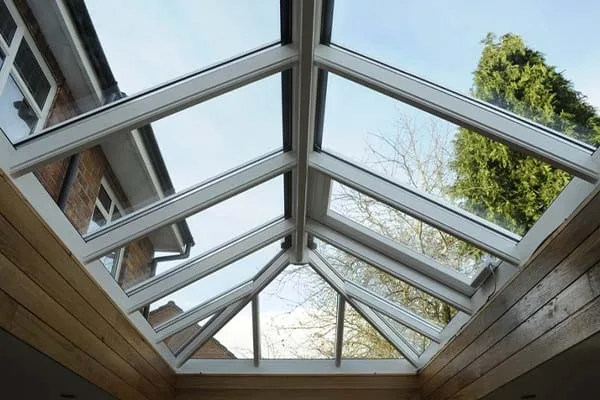
Start with purpose and orientation, then select the coating accordingly. Always look at whole-unit performance alongside the coating: good frames, warm-edge spacers and a laminated inner pane will improve winter comfort by lifting the interior surface temperature. Get the detailing right too. Upstands should shed water away from glass edges; drainage paths and weep holes should remain clear; blinds and automation should be planned with the glazing so you don’t trap heat against the pane. The headline here is simple: the coating does a lot, but the build-up and the junctions decide whether you feel the full benefit.
If you’re planning a renovation, it’s worth exploring flat vs pitched rooflights to see which design works best for your home.
What about glare, UV and furnishings?
Lower g-values tend to reduce glare in summer because less energy is entering the room; pair the glass with a light-coloured blind for fine control on film-watching afternoons.
A quick way to decide if it’s worth it
Walk the plan at 3 pm on a sunny day and look for the places where people actually spend time: the end of the sofa, the kitchen island, the home-office desk under a flat-roof opening. If the space already overheats on bright days or if summer glare pushes you to close blinds, you’re looking at a prime candidate for a solar-control specification. If the room is north-facing and chronically dim, prioritise visible light transmission first and choose a gentler coating or none at all so you don’t solve summer heat at the cost of winter gloom. The point isn’t to chase the lowest g-value on a spreadsheet; it’s to tune the glass to how the room is used.
Bottom line: solar control coatings let you enjoy the sky without importing its heat. Get the coating right, pair it with good frames and detailing, and you end up with spaces that look like architecture magazines and feel comfortable on the hottest day of the year.
If you’d like help matching coatings to orientation and room use, share a plan and a couple of photos.